Danger zone and approach zone — the three types of electrical work
This page has not yet been technically reviewed by a qualified person. Always check the current standard and your own appointment (aanwijzing); this is not a substitute for NEN 3140 or NEN 1010.
Danger zone and approach zone
Before deciding how to carry out a task, you need to know which zone you're in. NEN-EN 50110-1 defines two distances around a live part that together determine which measures are mandatory.
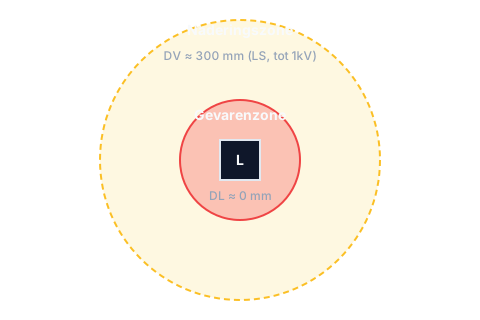
The two zones
| Zone | Symbol | Distance (low voltage, up to 1 kV) | Meaning |
|---|---|---|---|
| Danger zone | DL | ≈ 0 mm — the live part itself | Direct contact is life-threatening; accessible only to a VP, wearing the correct PPE, after a risk assessment |
| Approach zone | DV | ≈ 300 mm at low voltage up to 1 kV | Boundary within which extra precautions apply, even without contact (for example, at high voltage a flashover can occur) |
At high voltage, both distances are considerably larger, running up to metres at the highest voltage levels — the exact values are given in tables in NEN-EN 50110-1 and depend on the voltage.
Three types of electrical work
NEN-EN 50110-1 distinguishes three work categories, each with its own set of mandatory measures:
- De-energised work — the installation is demonstrably made free of voltage (via the 5 LOTO steps: switching off, securing against re-energising, verifying de-energised, earthing/short-circuiting, shielding neighbouring live parts). This is the default and preferred method of working.
- Live working (WOS) — only permitted when de-energising is not reasonably possible (for example a continuous process, or where de-energising itself creates a greater risk), and only by a VP with specific WOS training, adapted tools and PPE.
- Work in the vicinity — work that does not take place on the live part itself, but does take place within the approach zone. Requires shielding, marked boundaries or supervision, depending on the distance to the danger zone.
Operating versus working
A distinction that comes up regularly in exam questions:
- Operating (switching, turning something on or off via a control intended for that purpose, such as a switch or push-button) is not "working" within the meaning of NEN 3140, and — provided the control is designed for laypersons and correctly installed — may also be done by a Leek.
- Working (any action carrying a risk of contact with a live part, such as opening an enclosure, replacing a component, or measuring) requires at least a VOP for the specifically assigned action, or a VP for assessment and execution in a broader sense.
LMRA, TRA and RI&E — three levels of risk assessment
These three terms are often confused in the exam, but they operate on a different scale:
- RI&E (Risk Inventory & Evaluation) — the organisation-wide risk assessment of the company, mandatory under the Arbowet; drawn up and recorded periodically, not per task.
- TRA (Task Risk Analysis) — a written risk assessment drawn up in advance, per specific task or job: which risks, which measures, which PPE.
- LMRA (Last Minute Risk Analysis) — the short, personal check the person carrying out the work performs just before the work actually starts: does the situation still match the TRA, has anything changed since the preparation?
In short: the RI&E is the foundation at company level, the TRA translates that into the specific task in advance, and the LMRA is the final personal check right before the action itself.
Why this matters in practice
The classification into zones and work types directly determines which PPE, which tools and which authorisation (VP/VOP) are mandatory. A wrong judgement call — for example working "just quickly" within the approach zone without the correct shielding — is one of the most common causes of electrical incidents that proper preparation could have prevented.
Further reading
- PBMPPE for electrical work — overview and classifications
- VCAWork permit & LMRA — the last-minute risk analysis before electrical work
- NEN-EN 50110-1First aid for electrical accidents — rescue and resuscitation
- EN 2 / EN 3-7 / EN 3-11Fire extinguishers for electrical installations — there is no separate "fire class E", but there is a separate voltage test
- NEN-EN-IEC 60974Arc welding — electrical safety and open-circuit voltage
- NEN 2535 (EN 54)Fire detection system interface with the electrical installation (NEN 2535) — why an alarm should not cut the mains