Circuit breaker characteristics B, C and D — the real difference
This page has not yet been technically reviewed by a qualified person. Always check the current standard and your own appointment (aanwijzing); this is not a substitute for NEN 3140 or NEN 1010.
Circuit breaker characteristics B, C and D
A miniature circuit breaker (MCB) such as C16A has two properties: a number (In, the rated current) and a letter (B, C or D, the tripping characteristic). Both are printed on the breaker, but they protect against two different things.
- The number — the rated current
Inthe breaker carries indefinitely. This protects the cable against overload. - The letter — the range within which the instantaneous (magnetic) trip occurs on short-circuit. It determines how fast the breaker reacts to a short-circuit or earth fault.
In short: the number protects the cable, the letter determines how fast the breaker reacts to a short-circuit.
The thermal part is identical for B, C and D
Per EN 60898-1, all three characteristics share the same thermal (bimetal) protection:
- At 1.13 × In, the breaker must not trip within the conventional time (1 hour for
In ≤ 63 A). - At 1.45 × In, the breaker must trip within that same hour.
A B16, C16 and D16 behave identically under overload — all three trip around 23.2 A (1.45 × 16 A) within an hour. The difference lies entirely in the magnetic part.
The magnetic characteristic — the core table
| Characteristic | Instantaneous trip range | Example at 16 A | Typical use |
|---|---|---|---|
| B | 3–5 × In | 48–80 A | Homes, lighting, general socket outlets, long cable runs |
| C | 5–10 × In | 80–160 A | Motors, transformers, LED drivers, distribution boards with inrush currents |
| D | 10–20 × In | 160–320 A | Large motors with direct-on-line starting, welding equipment, X-ray equipment, heavy transformers |
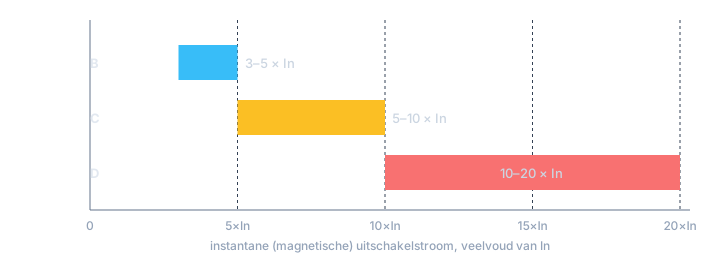
Less common: Z (2–3 × In, sensitive electronics) and K (10–14 × In, industrial per NEN-EN 60947-2).
Memory aid for the sequence: each letter roughly doubles the range — 3-5 · 5-10 · 10-20.
Why this matters in practice: loop impedance Zs
On a fault between line and protective conductor (PE), the breaker must trip within the required time (NEN 1010: 0.4 s for final circuits ≤ 32 A in a TN system at 230 V). Whether it does depends on the circuit's loop impedance Zs:
Zs × Ia ≤ U₀, where Ia is the instantaneous trip current and U₀ = 230 V.
| Breaker | Ia (upper bound) | Maximum allowable Zs |
|---|---|---|
| B16 | 5 × 16 = 80 A | 230 / 80 ≈ 2.88 Ω |
| C16 | 10 × 16 = 160 A | 230 / 160 ≈ 1.44 Ω |
| D16 | 20 × 16 = 320 A | 230 / 320 ≈ 0.72 Ω |
For the same cable length and cross-section, the allowable loop impedance drops sharply as the letter moves further through the alphabet. A D16 demands a loop impedance four times stricter than a B16 to trip within 0.4 s. Always measure Zs with an installation tester before swapping a breaker for a different characteristic.
Which letter to choose
- B — the default for residential and office circuits without inrush current: lighting, socket outlets, resistive loads. Gives the lowest Zs requirement, the most robust choice for long cable runs.
- C — where short inrush current peaks are normal: electric motors, transformers, switch-mode power supplies (LED drivers, computers), and upstream breakers feeding several B-circuits (selectivity).
- D — only for high inrush current: direct-on-line (DOL) motors, welding equipment, large transformers. Almost always requires a dedicated Zs calculation or measurement.
The classic exam question: can you swap a B16 for a D16?
No. The full reasoning:
- Thermally nothing changes — the cable stays equally protected against overload.
- Magnetically, a D16 only trips at 160–320 A instead of 48–80 A. The maximum allowable
Zsdrops from roughly 2.88 Ω to 0.72 Ω. - If the actual loop impedance exceeds that new limit, the required 0.4 s disconnection time is no longer met — dangerous touch voltage persists too long.
- Short-circuit protection of the cable itself at the far end of a long run can also fall short.
- This counts as a modification of the installation: only permitted after calculating or measuring
Zs/Ik, updating the diagram and circuit schedule, in agreement with the person responsible for the installation.
A like-for-like swap without further checks is only allowed if the new breaker has the same characteristic, same In, same number of poles and at least the same breaking capacity (Icn).
Icn — the other rating on the breaker
Besides B/C/D and In, every breaker also carries an Icn rating (e.g. 6 kA or 10 kA): the maximum short-circuit current it can interrupt without damage. This value must be at least equal to the prospective short-circuit current at the installation point — especially critical near the main incomer, where fault current is highest.
Selectivity — which breaker trips first?
On a fault, ideally only the breaker closest to the fault should trip, not the main breaker upstream — this is called selectivity. Rules of thumb:
- Fuse-on-fuse: selective when the ratio between rated currents is at least 1:1.6 (e.g. a 35 A main fuse above a 20 A circuit).
- Breaker under a fuse (or vice versa): because of the strongly non-linear tripping behaviour, a margin of 2 to 3 times the current rating is often needed, and this must be verified case by case using the manufacturer's selectivity tables — a simple ratio rule is not enough here.
- RCDs: only an RCD of the selective type (type S), with a delay of 130–500 ms, is selective relative to a fast RCD downstream. Two ordinary (non-selective) 30 mA RCDs in series are never selective — on an earth fault, both can trip at the same time.
Cable cross-section and breaker rating
The maximum In of a breaker depends on the cross-section of the cable it protects — a rough guideline (the exact value depends on the installation method, ambient temperature and the number of cables bundled together, per NEN 1010 annex 52):
| Cable cross-section | Indicative maximum In |
|---|---|
| 1.5 mm² | 16 A |
| 2.5 mm² | 20–25 A |
| 4 mm² | 25–32 A |
| 6 mm² | 32–40 A |
| 10 mm² | 40 A |
| 16 mm² | 63 A |
| 35–50 mm² | 160 A |
This table is a rule of thumb for a first estimate — final sizing always requires a calculation per NEN 1010 based on the actual installation conditions.
Further reading
- IEC 60898-1MCB thermal trip characteristic — why ambient temperature shifts the rating
- IEC 62619 / NEN 3140 (BMS)BMS cell balancing — passive versus active balancing in lithium battery systems, and what it means for inspection
- ExamenDutch for the practical exam — verbs and technical terms
- IEC 61230 (aardingsset)Earthing and short-circuiting sets — periodic testing per IEC 61230
- InspectieTesting the RCD — trip time and residual current (NEN-EN-IEC 61557-6)
- InspectieATEX explosion-hazard zones — classification & inspection