Fuse systems — Diazed, Neozed and NH
This page has not yet been technically reviewed by a qualified person. Always check the current standard and your own appointment (aanwijzing); this is not a substitute for NEN 3140 or NEN 1010.
Fuse systems — Diazed, Neozed and NH
Besides circuit breakers (MCBs, see the B/C/D characteristics), you'll still regularly encounter fuse systems in older and industrial installations. Three systems dominate Dutch practice.
Diazed (D-system)
The classic screw-cartridge system, recognisable by the porcelain fuse holder with screw thread.
- Adapter ring (passchroef): a ring fitted in front of the fuse link that physically prevents a cartridge with a higher current rating than intended from being inserted — the adapter ring is itself the first barrier against an incorrect replacement, independent of the fuse link.
- Fuse-holder numbering: the common designation "25/16" means a fuse holder rated up to 25 A, into which — via the adapter ring — a cartridge of at most 16 A is permitted.
Diazed cartridge colour code:
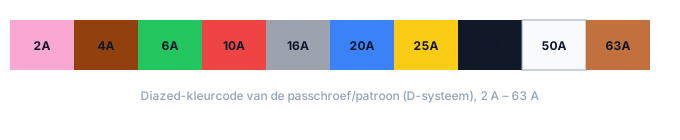
| Current | Colour |
|---|---|
| 2 A | Pink |
| 4 A | Brown |
| 6 A | Green |
| 10 A | Red |
| 16 A | Grey |
| 20 A | Blue |
| 25 A | Yellow |
| 35 A | Black |
| 50 A | White |
| 63 A | Copper |
Neozed (D0 system)
The successor to Diazed: more compact, with no separate adapter ring needed because the cartridge itself has a diameter/shape tied to its current rating that physically prevents incorrect insertion. Recognisable by the designation D01 (up to 16 A) and D02 (up to 63 A); for higher currents there's also D03 (up to 100 A).
NH knife-fuses (fuse-switch disconnector)
For higher power ratings: flat cartridges with knife-shaped contacts, mounted in a fuse-switch disconnector (also called a knife switch). Common in main distribution boards and industrial installations up to several hundred amps. An NH fuse link is always replaced with a dedicated fuse-puller — the fuse-puller tongs — (never bare-handed) and preferably with the circuit de-energised, after the load has been removed (see also the load-break switch / isolator rule).
Because removing a knife fuse carries a risk of arc flash, a mandatory PPE set applies: insulating gloves class 00 (500 V) or class 0 (1000 V), a face shield/visor, flame-retardant clothing free of synthetic fibres, and safety footwear S3 — in addition to the fuse-puller tongs themselves.
gG versus aM — the second letter matters
Every fuse link carries, alongside its current rating, a letter code describing its tripping behaviour:
- gG ("general purpose") — protects against both overload and short-circuit, suitable for general cable and line protection.
- aM ("accompagnement Moteur", motor protection) — protects exclusively against short-circuit and is deliberately slow on overload, so that a motor's inrush current doesn't cause unnecessary blowing. An aM fuse link must always be combined with a separate thermal motor protection device (motor-protection switch) for overload protection — an aM cartridge alone does not protect the motor winding against prolonged overload.
Never confuse the two: an aM fuse link on a cable without additional overload protection lets an overload continue unchecked far above the rated current.
Motor-protection switch (MBS) — what an aM fuse link doesn't do
A motor-protection switch (MBS) is a separate switching device, specifically designed to protect the motor winding against overload — precisely the gap an aM fuse link deliberately leaves open (see above). An MBS combines two protections in a single device:
- Thermal element — an adjustable, hand-calibrated dial that you set exactly to the rated current
Inon the nameplate of the connected motor. On overload, the MBS trips within a time that belongs to its trip class. - Magnetic element — a fixed, fast trip on short-circuit, comparable to the magnetic trip of a circuit breaker.
Trip classes (EN/IEC 60947-4-1) — the range within which the MBS must trip at 7.2 × Ie, starting from cold (class 10A shares the same maximum time as class 10, but has a lower minimum time — intended for applications that need a faster response without shortening the maximum trip time):
| Class | Trip time at 7.2 × Ie (min–max) | Typical application |
|---|---|---|
| 10A | 2–10 s | Very light starting, fast response wanted |
| 10 | 4–10 s | Standard motors, short start-up |
| 20 | 6–20 s | Heavier starting (pumps, fans) |
| 30 | 9–30 s | Heavy starting, large moments of inertia |
An MBS is almost always combined into a direct-on-line starter (DOL starter): aM fuses or a circuit breaker for short-circuit protection, the MBS for thermal overload protection, and a contactor to actually switch the motor on and off. In the exam and in practice you'll come across brands such as Eaton (PKZM0 series) and Hager (K series) for this — the principle (thermal + magnetic, separate from the fuse) is the same for every brand.
Most common mistake: setting the MBS dial to the current rating of the fuse or cable instead of to the motor's In. An MBS set too high doesn't protect the winding against overload; an MBS set too low won't even let the motor start. Always set the MBS based on the nameplate of the motor actually connected — see also replacing a motor, where this setting must be checked again as soon as the motor is replaced.
Comparison with circuit breakers
Just as with replacing a B16 with a D16 (see the B/C/D characteristics), the same applies to fuse systems: the current rating and tripping behaviour (gG/aM) belong to the circuit's design calculation. Replacing a cartridge with a higher rating or a different type without recalculating the cable protection and disconnection time is a modification of the installation, not a simple maintenance action.
Further reading
- NEN-EN-IEC 60974Arc welding — electrical safety and open-circuit voltage
- IEC/EN 62305-3 bijlage EPeriodic inspection of a lightning protection system (LPS) — IEC/EN 62305-3 test intervals
- IEC 61496 / ISO 13855Light curtains (ESPE) — type 2 versus type 4, and the safety-distance formula
- ScopeNEN-EN-IEC 60204-1 — electrical safety of machinery
- IEC 61508 (proof test)Safety relays and safety PLCs — periodic proof testing per IEC 61508
- IEC 61230 (aardingsset)Earthing and short-circuiting sets — periodic testing per IEC 61230